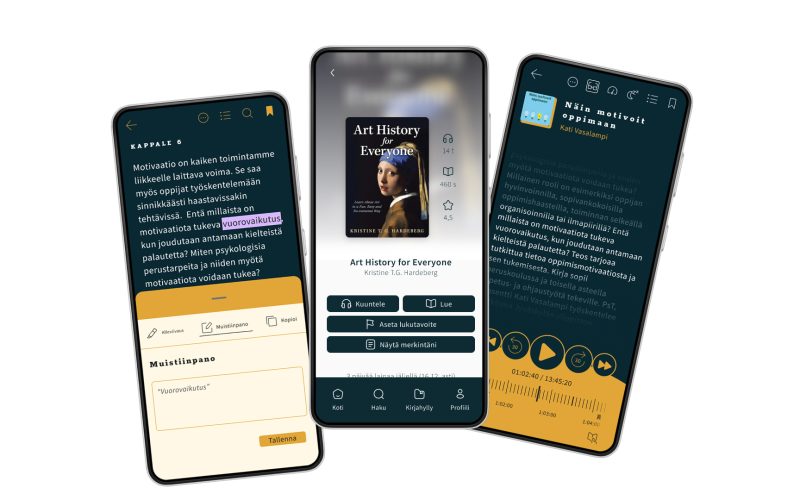
Generative AI burst into the day-to-day life of people with the launch of ChatGPT, a chatbot built on large language models. As part of the Lingsoft Group, Ellibs is involved in developing AI applications that will provide smoother access to literature.
At Ellibs, AI applications have already been considered from the user experience perspective, and more applications are identified constantly.
AI is predicted to speed up transformation in many sectors, and the book industry will not be an exception. For a long time, technological development has brought new applications to the market; e-books became popular during the 2010s, and the use of audiobooks has increased throughout the 2020s.
“In a way, e-books are a mix between print and the new wave of digital literature. Audiobooks, on the other hand, differ more from print books in how they are used, and the development won’t stop here,” says the CEO of Ellibs, Juha Tarvainen.
At best, technological advancements and new applications bring significant additional value to the reader. For example, AI-created summaries, definitions and keywords can support learning and the findability of content. Technology can also streamline the literary process for both author and publisher.
“Language models are constantly developing, which improves not only text-production solutions but also speech recognition, artificial speech and automated translation tools. In the future, native-language books can be produced even faster. User experience can also be personalised in other ways for different readers and ways of reading during the actual use,” Mr Tarvainen adds.
Digital literature is indeed a question of equality. For example, library customers can borrow electronic materials outside the library’s opening hours or location, and AI-assisted tools enable people with vision and hearing impairments to consume books independently.
Benefits bring questions
In addition to solutions, new technologies bring new challenges. Around the world, AI has been used to generate images in the style of various artists. Similar examples can be found in literature, and in the early stages, the models have been trained without much concern for permissions. Alongside copyright questions, there is an increasing focus on the responsible development and use of AI. Common ground rules will have to be re-written.
“For better or for worse, the amount of AI-produced content online is constantly increasing. Critical literacy gives us tools to survive in a new kind of future. People are currently seeking solutions for situations where both students and teachers use AI to generate text and to assess the results. It is essential to find a balance, so that technology can be utilised in the best possible way. Instead of cutting corners in the short term, long-term solutions can be created to support the new needs of readers,” Tarvainen says.
The value of AI depends on the solutions
For literature, one of the most interesting AI applications is enrichment, allowing materials to be analysed and supplemented with diverse information without changing the original text. In addition, materials can be seamlessly combined, translated or switched from one format to another. The richer the material, the better it functions in digital environments.
“To my mind, the current static interfaces will fade away over time, as future AI will adapt to the needs of the user. In the book industry, content will also adapt, and enriched materials are the key to this. It will be faster for users to find the information they are after or access the source of content in a manner that suits them.
“New technologies and devices always mean new ways to act. Of course, IT hypes are born and die all the time, and grasping the change is more difficult once the initial excitement has passed. Only then will we see how the world changes in the long run. Nevertheless, Lingsoft has developed AI and language technology for years that aims at this change and offers a huge range of possibilities. It’s great to be part of this development and combine it with the needs of the book industry,” Tarvainen concludes.
Categories: